



The Real Cost of Building Without Coordination
A $200 million commercial tower in Doha. Three months into construction, the MEP subcontractor discovers the main chilled water riser collides with structural shear walls on six consecutive floors. The structural drawings said one thing. The mechanical drawings said another. Nobody caught the conflict during design.
The cost to fix it: $2.4 million in redesign, demolition, and schedule delay. The cost to have caught it in a clash detection run during the coordination phase: a few hours of BIM coordination time.
This is not a hypothetical. Variations of this scenario play out across GCC construction sites every quarter. The industry average for rework sits between 5% and 30% of total project cost, depending on complexity. On a $100 million project, that is $5 million to $30 million in avoidable waste.
3D BIM modeling does not eliminate every risk. But it eliminates the category of risk that comes from teams working in isolation, producing documents that contradict each other, and discovering conflicts only when steel is already in the ground.
How BIM Cuts Costs Before Construction Starts
The savings start in preconstruction, not on the job site. When architectural, structural, and MEP systems are modeled in a single federated environment, spatial conflicts become visible the moment they’re created. Not six months later when a pipe fitter is standing in front of a beam that shouldn’t be there.
Automated clash runs in Navisworks can process hundreds of thousands of intersection checks in minutes. On the Lusail F1 Circuit upgrade, this process identified and resolved 1,200+ conflicts before steel fabrication began. Each of those conflicts, if discovered on-site, would have triggered RFIs, design changes, material reorders, and schedule delays.
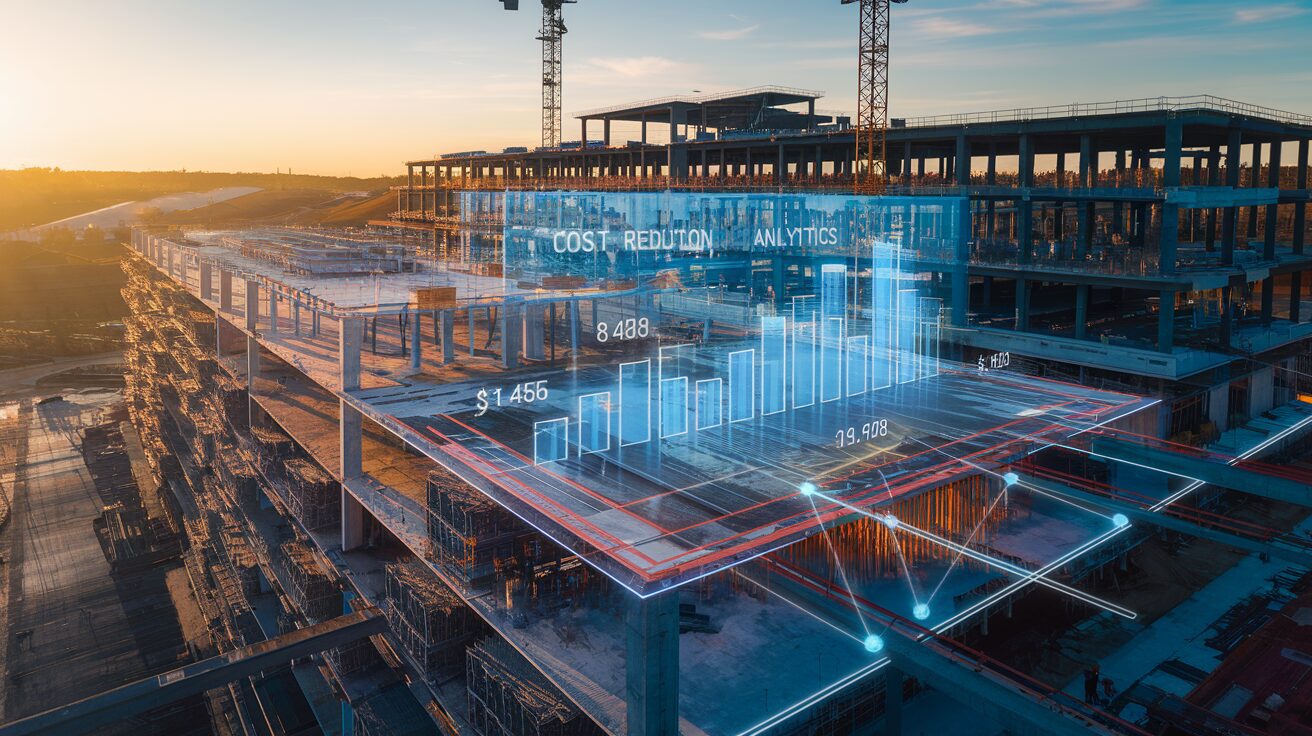
5D BIM cost estimation takes this further. When the model is linked to cost data, every design decision carries a visible price tag. Move a wall, the budget updates. Swap a facade system, the quantity takeoff recalculates. Decision-makers see cost implications in real time instead of waiting for the QS to reconcile spreadsheets weeks later.
Model-based quantity take-offs also reduce the margin of error in procurement. Traditional take-offs from 2D drawings carry a 10-15% error rate on complex projects. BIM-based extraction cuts that significantly because the quantities come directly from the geometry, not from manual measurement of flat drawings.
How BIM Compresses Project Timelines
Time savings from BIM come from three places: parallel workflows, faster decision cycles, and fewer on-site surprises.
In a traditional workflow, disciplines work sequentially. Architecture finalizes, then structure starts, then MEP follows. Each phase waits for the previous one. In a federated BIM workflow, all three disciplines model simultaneously within the same coordinated environment. Design conflicts surface and resolve during the design phase, not during construction.
4D BIM scheduling connects the model to the construction sequence. Project managers can simulate the build, identify phasing conflicts, and optimize crane placement, material staging, and trade sequencing before mobilization. On complex projects with tight handover dates, this kind of pre-construction simulation can compress timelines by weeks.
RFI reduction is another major factor. Projects that rely on 2D documentation generate significantly more requests for information because drawings are ambiguous. A coordinated BIM model provides a single source of truth. When the contractor can interrogate the model directly, the RFI count drops, and with it, the decision latency that stalls progress on site.
| Traditional Workflow | BIM-Coordinated Workflow |
|---|---|
| Sequential design phases | Parallel multidisciplinary modeling |
| Clashes found during construction | Clashes resolved during design |
| Manual quantity take-offs (10-15% error) | Model-based extraction (geometry-accurate) |
| 2D drawings generate high RFI volume | Federated model reduces RFIs significantly |
| Schedule conflicts discovered on-site | 4D simulation identifies phasing issues pre-construction |
| Cost impacts visible weeks after changes | 5D BIM shows budget impact in real time |
Why This Matters in the GCC
The GCC construction market is running some of the most complex projects on earth right now. Saudi Arabia’s Vision 2030 pipeline alone includes NEOM, The Red Sea, Qiddiya, and dozens of giga-projects with compressed timelines and aggressive handover targets. Qatar continues to build on its post-World Cup infrastructure momentum. The UAE is expanding across hospitality, logistics, and mixed-use developments.
At this scale, the cost of poor coordination multiplies fast. A single unresolved clash on a $5 billion giga-project does not cost the same as it does on a $20 million villa. The financial exposure scales with project complexity, and so does the value of catching problems early.
ISO 19650 compliance is becoming a baseline expectation across the region. Government authorities in Qatar (Ashghal, Qatar Rail) and Saudi Arabia are increasingly specifying BIM deliverables in their tender requirements. Projects that cannot demonstrate a compliant BIM Execution Plan risk disqualification before they even start coordination.
The firms that invest in proper BIM coordination up front are not spending more. They are spending earlier, on problems that cost a fraction to fix in the model compared to what they cost on-site. On the Panda Zoo project in Al Khor, full multidisciplinary BIM coordination delivered an Ashghal-approved, completion-certified result. That kind of outcome does not happen by accident. It happens because the coordination investment was made during design, not patched together during construction.
The Execution Gap
Having a BIM model and having effective BIM coordination are two different things. Many projects have models. Fewer have models that are actually federated, checked for clashes on a structured cadence, and maintained as a single source of truth across all disciplines.
The execution gap shows up in projects where each discipline models in isolation, nobody runs regular clash detection, and the federated model exists only as a deliverable checkbox rather than an active coordination tool. These projects still find their clashes. They just find them on-site, in concrete and steel, where the cost to fix is 10x to 100x what it would have been in the model.
Effective BIM coordination requires process discipline: structured model audits, regular federated reviews, clear responsibility matrices, and a Common Data Environment that keeps everyone working from the same information. It also requires the right team. BIM staffing decisions directly impact coordination quality.
The difference between a project that uses BIM and a project that benefits from BIM is the rigor of the coordination process behind the model. On the Msheireb Bus Station, complex MEP coordination across multiple systems delivered a result that earned a client feedback letter from Al Sraiya. That kind of coordination outcome reflects process maturity, not just software licenses.
Frequently Asked Questions
Industry data shows BIM coordination can reduce rework costs by 40-80% on projects where it is implemented rigorously. On a $100 million project, that translates to millions in avoided change orders, material waste, and schedule delays. The exact savings depend on project complexity, the number of disciplines involved, and how early coordination starts. Our ROI analysis breaks this down in detail.
Both. BIM reduces costs through clash detection and accurate quantity take-offs. It compresses timelines through parallel design workflows, 4D scheduling simulation, and fewer RFIs during construction. The timeline compression is often more valuable than the direct cost savings because it accelerates revenue generation for the asset owner.
A BIM model is a 3D digital representation of a building. BIM coordination is the process of federating multiple discipline models, running automated clash detection, resolving conflicts systematically, and maintaining the model as a single source of truth. The model alone does not reduce costs. The coordination process does.
BIM coordination delivers value on any project with multiple disciplines and spatial complexity. A 10,000 sqm commercial building with MEP, structural, and architectural systems will have hundreds of potential clash points. The coordination cost is a small fraction of the rework cost if those clashes reach the site.
GCC projects face unique schedule pressures: extreme heat windows that limit site work, regulatory approval cycles, and compressed timelines driven by national vision deadlines. BIM coordination front-loads problem-solving into the design phase, reducing the on-site surprises that cause delays. ISO 19650-compliant workflows also streamline the approval and handover process with government authorities.
Conclusion
BIM does not reduce construction costs by being a better version of CAD. It reduces costs by changing when problems get solved. Every conflict resolved in the model is a change order that never gets issued, a material reorder that never happens, and a schedule delay that never materializes. The investment in coordination during design is consistently smaller than the cost of fixing problems during construction. For complex projects in the GCC, where stakes are high and timelines are tight, that shift from reactive to proactive is the difference between a project that finishes on budget and one that spirals.